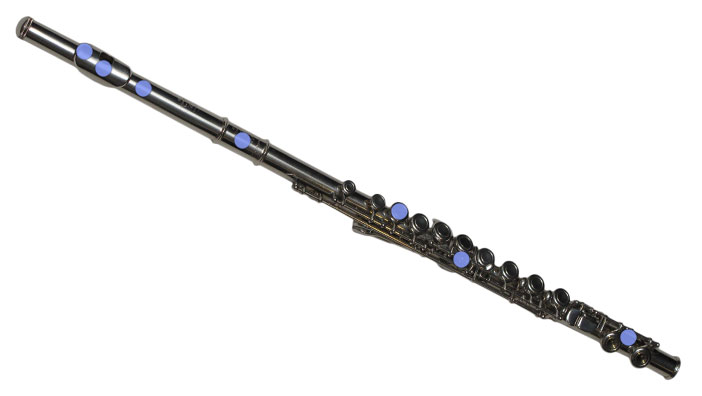

Concert flute – History The flute is one of the oldest musical instruments of all and is regarded as the first ever wind instrument. It has been in use at least since the Stone Age. Flute playing has a particularly long tradition in the Orient. The Sumerians and Egyptians were among the first to add three or four finger-holes to their bamboo flutes, which enabled them to produce several notes. The Ancient Greeks also had quite sophisticated flutes, which were blown at the open upper end and had six finger-holes. However, the flute was regarded as an instrument of the common man and as such was held in scant regard. In contrast, the aulos , a distant precursor of the oboe, was always associated with high social standing. The flutes used in today’s orchestras are transverse flutes, as opposed to the Greeks’ end-blown flutes and the (modern) recorder. The first evidence of the use of transverse flutes in Europe comes from Etruscan iconographs from the 4th to the 1st centuries BC. Side-blown flutes were also known to the Romans. The Middle Ages and the Renaissance – drums and consorts Between the fall of Rome and the 11th century no evidence is known to exist for the use of transverse flutes. It is probable that the instrument returned to the West from the Orient by way of the Byzantine Empire. The transverse flute of the Middle Ages was made of a single piece of wood and had six finger-holes. It was used in military contexts and was even played at court. Traveling minstrels acquainted their audiences with it all over Europe, and since they originally came from Germany the instrument also became known as the fistula Germanica. It was usually accompanied by a drum. In the 16th century the flute consort, an ensemble consisting of three different-sized transverse flutes, became an established part of musical practice. At the same time broken consorts, ensembles combining various instruments such as the viol, lute and flute, were also popular. The most common flute was in D and had a range of D4–D6 (which could be extended if the player was skillful enough). Since the instrument was tuned to D the notes of other keys could only be produced either by half covering the finger-holes or by using cross-fingerings. This gave the instrument a certain chromaticism but meant that intonation remained uncertain, which placed the flute at a disadvantage compared to the other woodwinds. Baroque – the sound ideal remains unattainable From the middle of the 17th century the flute underwent several sweeping changes. From 1660 onward it consisted of three separate parts: the cylindrical headjoint, the body with six finger-holes, and the footjoint. The body and footjoint were conical. An additional hole was added to the footjoint and fitted with a key to make D# playable. These innovations, which probably originated from the Hotteterres, a French flute-making family, represent the start of the development of the transverse flute as we know it. In 1681 a Hotteterre flute with a range of 2½ octaves (D4–G6) was used in Jean-Baptiste Lully’s (1632–1687) opera orchestra, its first appearance in an orchestra of this type. Its wide range and brilliant timbre meant that the transverse flute soon became a serious rival to the recorder. The recorder (or fistula Anglica), an end-blown instrument, had originated in England and gained popularity in Europe at the same time as the transverse flute, becoming established as an orchestral instrument. But from the middle of the 18th century the description flauto in musical scores no longer referred to the end-blown recorder but the transverse flute (which had hitherto been described as the flauto traverso). The sound quality of the baroque transverse flute was still far from homogeneous and consistent, however. The irregularities in its range and the subsidiary notes which resulted from the use of cross-fingerings and had a different timbre were felt to be irksome in modulations. If it was possible to compensate for the shortcomings of the baroque flute’s intonation then only by means of exceptional virtuosity. The common practice of changing the body only accentuated these problems; to achieve a different tuning it had become customary to insert either a longer or shorter body, but no change was made to the arrangement of the finger-holes, which would have been necessary to accommodate the instrument’s altered acoustic properties. The introduction of the exchangeable body is attributed to the virtuoso flutist Pierre Gabriel Buffardin (ca. 1690–1768). Efforts to improve the transverse flute soon spread from France to other countries. The Prussian flutist and composer Johann J. Quantz (1697–1773), Frederick the Great’s flute teacher, studied the intonation problems of the instrument in great detail, later becoming a flute maker himself. He invented the tuning slide, experimented with various shapes and sizes of tone hole and added another key. These improvements, along with his treatise “Versuch einer Anweisung, die Flöte traversiere zu spielen” (An Essay on Instruction in the Art of Playing the Transverse Flute), published in Berlin in 1752, and his approximately 400 compositions for the instrument (chiefly concertos for flute and strings) boosted its popularity and brought it to the attention of ever more composers.

Published
 Music Instrumenets