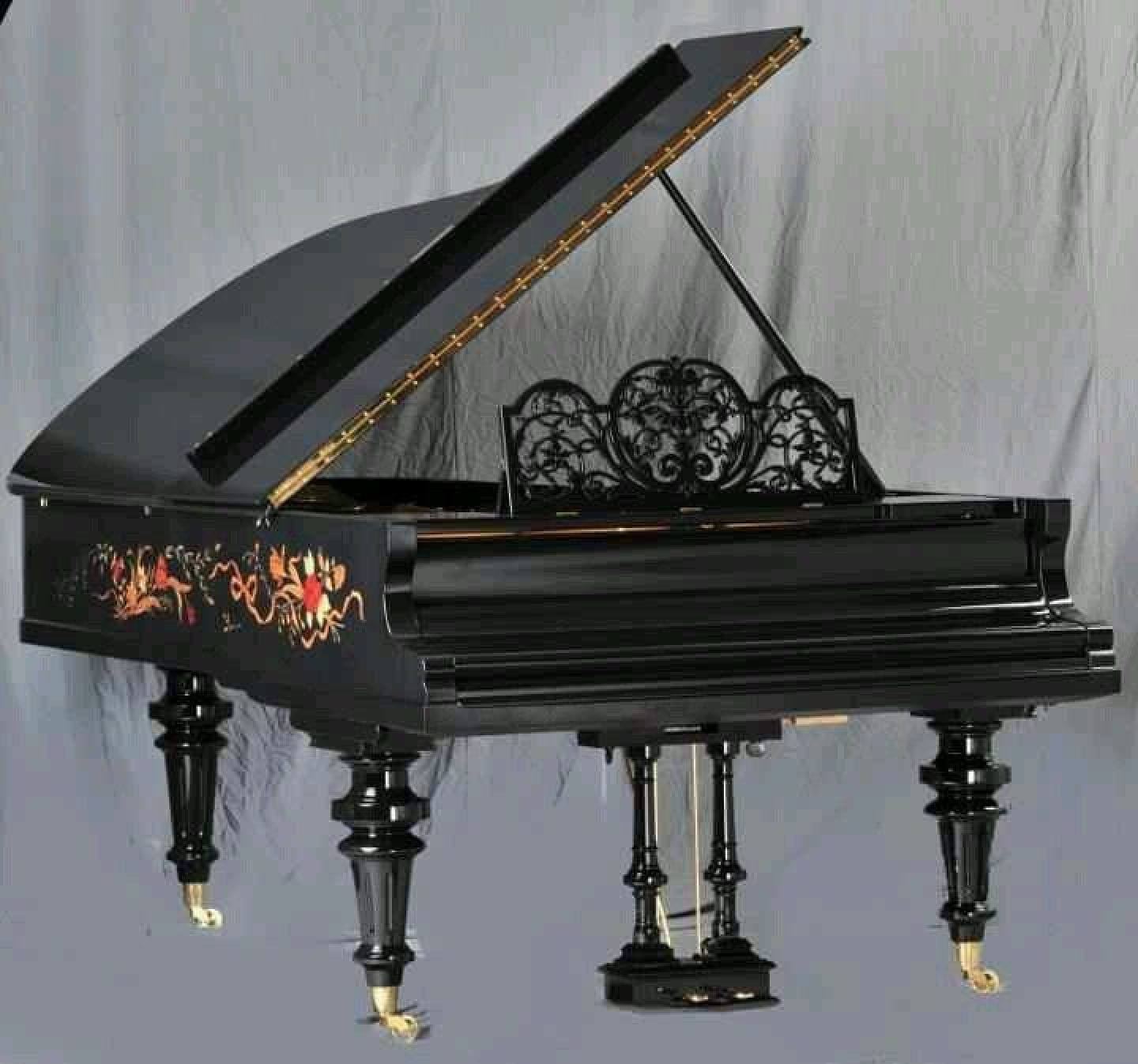

The story of the piano begins in Padua, Italy in 1709, in the shop of a harpsichord maker named Bartolomeo di Francesco Cristofori (1655-1731). Many other stringed and keyboard instruments preceded the piano and led to the development of the instrument as we know it today. Mankind’s knowledge that a taut, vibrating string can produce sound goes back to prehistoric times. In the ancient world, strings were attached and stretched over bows, gourds, and boxes to amplify the sound; they were fastened by ties, pegs and pins; and they were plucked, bowed or struck to produce sounds. Eventually, a family of stringed instruments with a keyboard evolved in Europe in the 14th century. The earliest of these was a dulcimer, a closed, shallow box over which stretched wires were struck with two wooden hammers. The dulcimer led to the development of the clavichord, which also appeared in the 14th century. These were followed by the spinet, virginal, clavecin, gravicembalo, and finally, the harpsichord in the 15th century. The harpsichord, however, was limited to one, unvarying volume. Its softness and loudness could not be varied while playing. Therefore, performing artists could not convey the same degree of musical expression as that of most other instruments. The artistic desire for more controlled expression led directly to the invention of the piano, on which the artist could alter the loudness and tone with the force of one’s fingers. The harpsichord was a particularly important development leading to the invention of the piano. Its ability to project sound more loudly than its predecessors, and refinements in the action (or touch) inspired many more musicians to compose for the keyboard and thus, to perform keyboard works. First exhibited in Florence in 1709, Cristofori’s new instrument was named gravicembalo col piano e forte (roughly “soft and loud keyboard instrument”). Eventually, it was shortened to fortepiano or pianoforte, and finally just piano. His earliest surviving instrument dates from 1720 and is on display at the Metropolitan Museum of Art in New York City. Despite many improvements during the past 300 years, it is truly astonishing to observe how similar Cristofori’s instruments are to the modern piano of today. New Technology in Pianos We are living in perhaps the most exciting time in history to buy, own or play that eternal instrument, the piano. Whether your goal is to purchase something as small as software that can record what you play, a newly designed player piano, a digital instrument or a classic acoustic model, there have never been as many choices for the consumer.

Published
 Music Instrumenets